This month, Play:Disrupt’s co-director Malcolm Hamilton talks with associate artist Amy Rose about ways that past experience as street performers have influenced their approach to designing and delivering creative community engagement.
Amy: I thought we could have a chat about how street theatre has shaped what we do now. How did your work as a street performer evolve into Play:Disrupt?
Malcolm: I can see a really clear through line. All the main elements of street performance are still part of our practice; play, improvisation, collaboration, narrative, theatricality. It’s first about making a good invitation to the public— something intriguing, but relatable. Before Play:Disrupt, we used to do a scaled up version of the word-guessing game Hangman. We had a big set and built a part-puppet-part-human figure in response to the public guessing letters. We toured it to street festivals. We chose something that was familiar to people and that meant that there was already a little common ground to build on. After that, we became interested in playing more with space, though, so our next show was Massive Battleships— again a familiar game, but scaled up to play across large spaces— a town square or harbour or wherever. That worked really well. I think it was around then that I started to see how these forms might be a way to have more impact, engage people and raise concerns about issues. So we made The People Versus the Octopus, inspired by Ferguson’s Gang, as a kind of exploration of what that might look like. That was when things started to really pivot into addressing regeneration, gentrification and so on. And you were making a similar pivot on your MA around that time, I think.
Amy: Yes, having toured my street show to festivals in all kinds of places, then landing in Bristol with two young children, I noticed I was becoming really preoccupied by public space and I needed to get my head around it.
Malcolm: Yes, me too! ‘Preoccupied by public space’— that’s a good way to put it.
Amy: My MA looked at arts practices at the intersection of placemaking, performance and play. And I noticed that the practice of people working on creative placemaking in the public realm really aligned with the skillsets of performers who work collaboratively in outdoor performance. Devising, designing, improvising and working in partnership with communities, creative live, situated events. These are the skills needed for participatory forms of engagement, co-production and co-design, in placemaking, but also so relevant in other sectors.
Malcolm: I think a lot also, about the way that being a street performer is about putting the public’s experience at the centre of everything. Giving people a really positive experience.
Amy: It’s true–the democratic nature of street performing is also present in community engagement. At a street show, people have agency and choice. It they don’t want to be there or like it, they can leave! If they do want to be there, they can stay and add their presence to the whole experience and have a great time. I had a friend who used to actually make this kind of deal with the audience before every show. Audiences vote with presence and proximity. They choose how involved they want to be to the main action. This is all really relevant to how you work with communities. When you add some of the things that we know make things engaging, like interactive games, humour, narrative, visuals and so on, it really makes the experience more impactful.
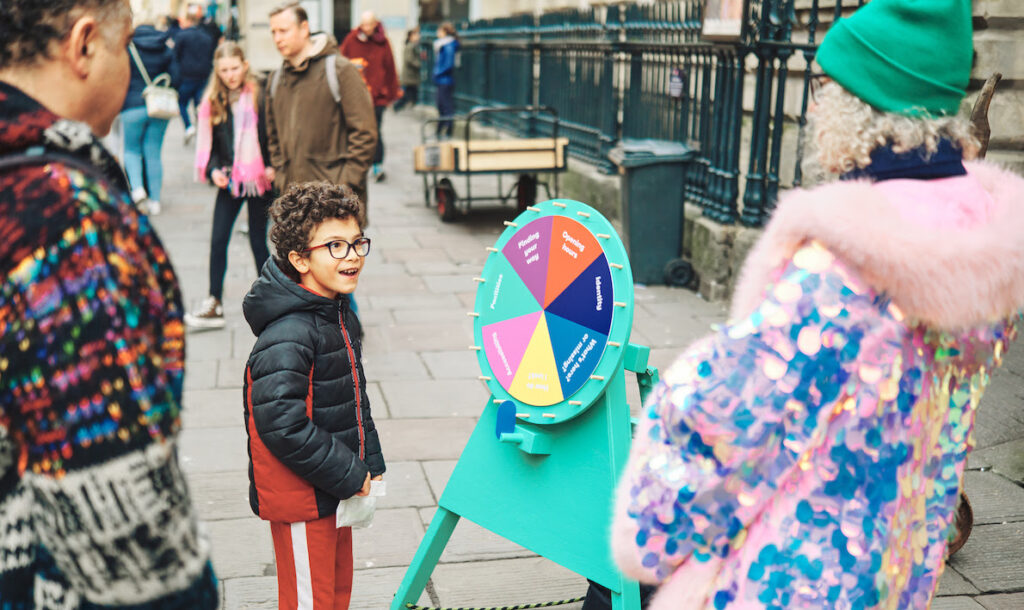
Malcolm: Absolutely. It’s a lot about the invitation, I think. The other day, in St. Nicholas’s Market, there was a man whose feedback afterward was ‘…if you’d come at me with a clipboard, I’d have run a mile’. Instead, we had made an offering using colour, moving parts and and quick games. Our spinning wheel, for instance is physically inviting and fairly familiar to most people. And through that, people’s curiosity is sparked and they choose to join in. We spend time making sure the materials, props and even our outfits are inviting. We don’t jump out at people, we draw them in.
Amy: Right. but once in, you can’t assume folks will stick around. We definitely learned that as street performers. You need to be able to build on that initial invitation or the whole thing flops!
Malcolm: So for that, we draw on what we know about building drama, suspense, narrative, structuring an experience, or engagement that has a pay-off. That people can go on a journey with us and feel that they’ve not only had some fun in the moment, but that they’ve been heard and their input has been valued. When we see the ideas from the consultation phase coming through in the built designs, or in follow-on events happening in the places we’ve worked, that have been shaped by ideas that came up through the engagement. You can see how –Wow- that really works, and the public know it- feel it, they appreciate it and are validated by it. That’s a really gratifying part of the work.
Amy: I agree. At the end of a street show, I used to enjoy the applause. The pay-off was a momentary sense of validation and accomplishment. But I find this work more satisfying. There’s a lasting sense of achievement that comes from using creativity to foster agency, connection and change within a community.
Malcolm: And being involved in those ways changes how people relate to the outcome. We love seeing peoples ideas coming into designs for work we’ve led over the past few years. Yeah, that’s deeper than applause, for sure.
News
Neurodiversity Informed approaches to engagement
Malcolm has recently published a blog for Neurodiversity in Planning. The article gives an account of the neurodiversity‑informed approach we take to accessibility and how that shapes the design, engagement and delivery of our work. The blog describes in detail the approaches we took to working with young people on the Isle of Anglesey (Ynys Mon), co-creating innovative mapping methodologies to support them to convey their connection to place. That project, Symbology- was awarded a Thornton Education Trust Inspire Future Generations Award in Jan 2026. You can read the blog here.
Ready…Steady….Engage!!!
We had a great time running a theatrical public consultation at St Nick’s Market. We designed a series of activities called “Ready, Steady Play”. It enabled us to showcase what high quality, rigorous community engagement can look like, when we aim to make civic conversations fun, enticing, and accessible. Over 850 people took part in our activities at pop-up locations across the market over the course of 10 days. It was a pleasure to work with the market team and with Bristol City Council on this engagement. (photo by Jack Offord)
Playing Out and Beyond
Last week, Playing Out held a celebration of sixteen years of grassroots organising, direct action, policy change and extensive ripples in relation to children’s right to play outdoors and have safe access to play on their doorsteps. Starting with a pilot of temporary streets, the project has grown to into a movement of neighours and professionals who take action in many ways. Malcolm attended the Bristol City Hall event on the 12th and also supported our associate, Amy Rose, to deliver two playfully disruptive offerings; Essential Repair and Public Skipping Service. Amy was a co-founder of Playing Out and was artist in residence from the origins of the project through 2017. Playing Out will now wind down the CIC, but the website and related projects will continue to support resident-led street play for years to come! Stay in touch!
Play Disrupt in Cambridge
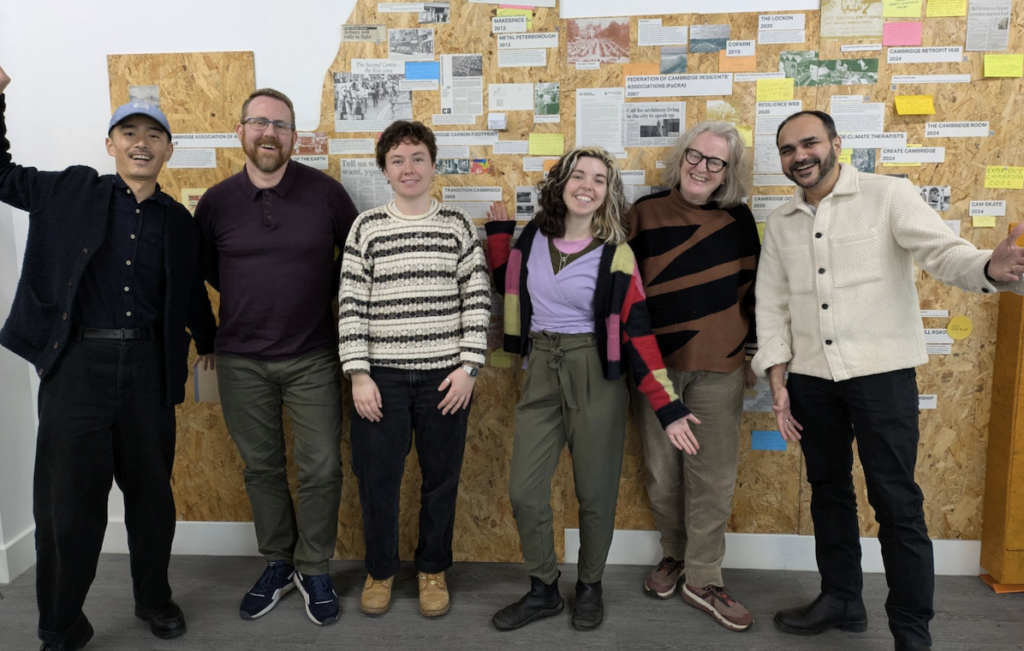
We’ve just returned from visiting Cambridge Room to plan our next round of workshops and events as part of our research with local communities and young people on the Public Map | Map Cyhoeddus. We’ll be engaging the local community with the digital map platform, developing it with young people, and giving them a space to express how they feel about where they live. Also, watch for upcoming events at the Cambridge Room, where we’ll be using theatre and play to activate and engage with local people (look out for the spinning wheel and pink sparkly jackets!
|